
Stanly County Release Date Meaning
North Carolina Department of Adult Correction uses the exact field name Projected Release Date in the incarceration-period section of Offender Public Information. It is a sentence calculation based on the record as it stands. The same historical period may later retain both Projected Release Date and Actual Release Date. The first is forward-looking. The second records the event that occurred.
That distinction also separates custody from legal discharge. A person may leave Albemarle Correctional Institution and enter post-release supervision. The Actual Release Date confirms the end of physical state-prison custody for that period, while an active supervision status shows that the sentence has not fully terminated. A move to another prison, county jail, ICE, or a federal custodian is a transfer, not community release.
Locate Stanly County Release Dates
The correct lookup starts by identifying the custody system. DAC records cover people who served a North Carolina prison sentence or were under state probation, parole, or post-release supervision. They do not contain an ordinary Stanly County jail booking or bond-out. Ralph McSwain Detention Center and the state prison near New London therefore require different routes.
- Decide whether the person is a pretrial county detainee, a local sentenced inmate, or a sentenced state prisoner.
- For state custody, open DAC Offender Public Information and begin under All so active supervision is not missed.
- Search by offender number when known, or use name with birth date or age to separate similar results.
- Open the matching detail and find the most recent period of incarceration, not just the first historical sentence shown.
- Read Projected Release Date with Sentence Status, Service Status, minimum and maximum terms, punishment type, and supervision fields.
- For Ralph McSwain custody, ask Booking or records for the jail's calculation and compare it with the court judgment and any later order.
Booking at Ralph McSwain can be reached at 704-986-3739. The public Sheriff roster has booking and current-custody details but no projected release field or released archive. When a documentary answer is needed, the county Public Information Request form can seek the existing release event or calculation record. The broader Stanly County released inmate lookup explains how Sheriff, court, DAC, and federal results fit together.
Note: Begin under All because a person outside prison may remain active in DAC under post-release or parole supervision.
Stanly County DAC Date Fields
A DAC detail can hold several incarceration periods and several kinds of status. Select the most recent relevant period and read the fields as a group. An old Actual Release Date does not prove anything about a newer admission, and an inactive label alone does not state when physical custody ended.
| DAC field | What it contributes |
|---|---|
| Projected Release Date | The current forward-looking sentence calculation, subject to lawful change. |
| Actual Release Date | The recorded physical release event for that incarceration period. |
| Inmate Status | Indicates the person's current published prison or post-release condition. |
| Service Status | Helps show whether the term is in prison, post-release, or another service phase. |
| Sentence Status | Shows whether the sentence period remains active or has another published status. |
| Minimum and maximum terms | Provide the paired sentence limits used with North Carolina calculation rules. |
| Supervision status and office | Shows whether legal oversight continues after physical prison release. |
The separate DAC Inmate Release Search can find recent state-prison releases by county, year, month, or name. Its results show offender number, name, release date, primary offense, and type of release. A STANLY release-county choice does not make it a Ralph McSwain jail feed. Open the full DAC detail to interpret a result such as parole or return to parole and to see whether supervision remains active.
The official DAC offender-search help documents how the public state search should be read.
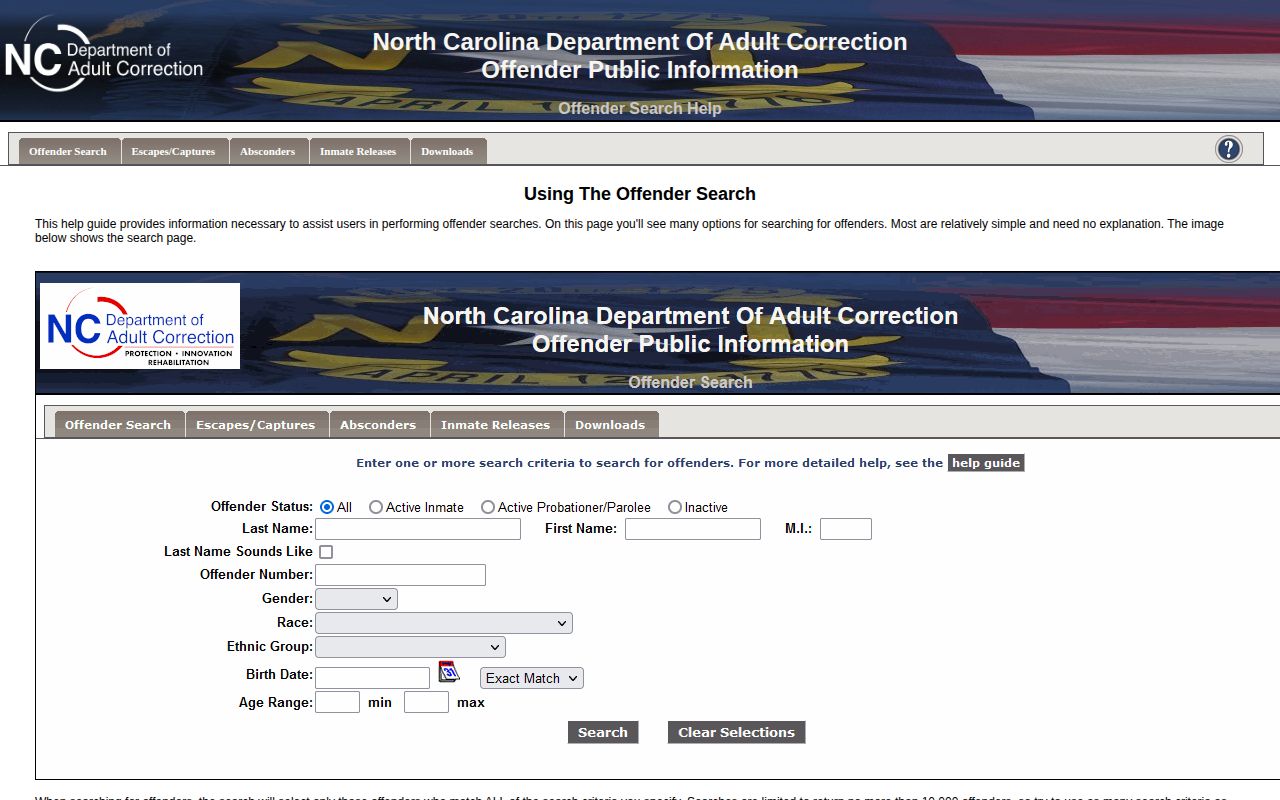
The help screen supports a careful state-record search, but the detailed incarceration period supplies the projected and actual date fields.
Stanly County Earned-Time Rules
North Carolina Structured Sentencing uses paired minimum and maximum terms. Under G.S. 15A-1340.13(d), a person serving active felony punishment must serve the imposed minimum term. Earned-time credit may reduce the maximum term, but it ordinarily cannot reduce confinement below that minimum. G.S. 148-13 supplies authority for DAC rules on custody grades, privileges, and earned or gain time administration.
Release from prison is often the start of post-release supervision, not sentence expiration. Under G.S. 15A-1368.2(a), the release calculation depends on felony class and sentence structure. For Class B1 through E, release generally occurs at the maximum term less 12 months and earned time. For Class F through I, it generally occurs at the maximum less nine months and earned time. A maximum set under G.S. 15A-1340.17(f) uses the statute's 60-month subtraction and earned time. The statutory period is subtracted even when no earned time exists.
Subsection (c) generally sets 12 months of post-release supervision for Class B1 through E and nine months for Class F through I. It provides five years for a reportable sex offense. Subsection (d) permits a limited reduction in the supervision period for compliance with specified reintegrative conditions, capped at 20 percent of the original supervision term. Sentence termination comes after completion of post-release supervision under subsection (f).
The minimum-term and earned-time statute appears in the official source image below.
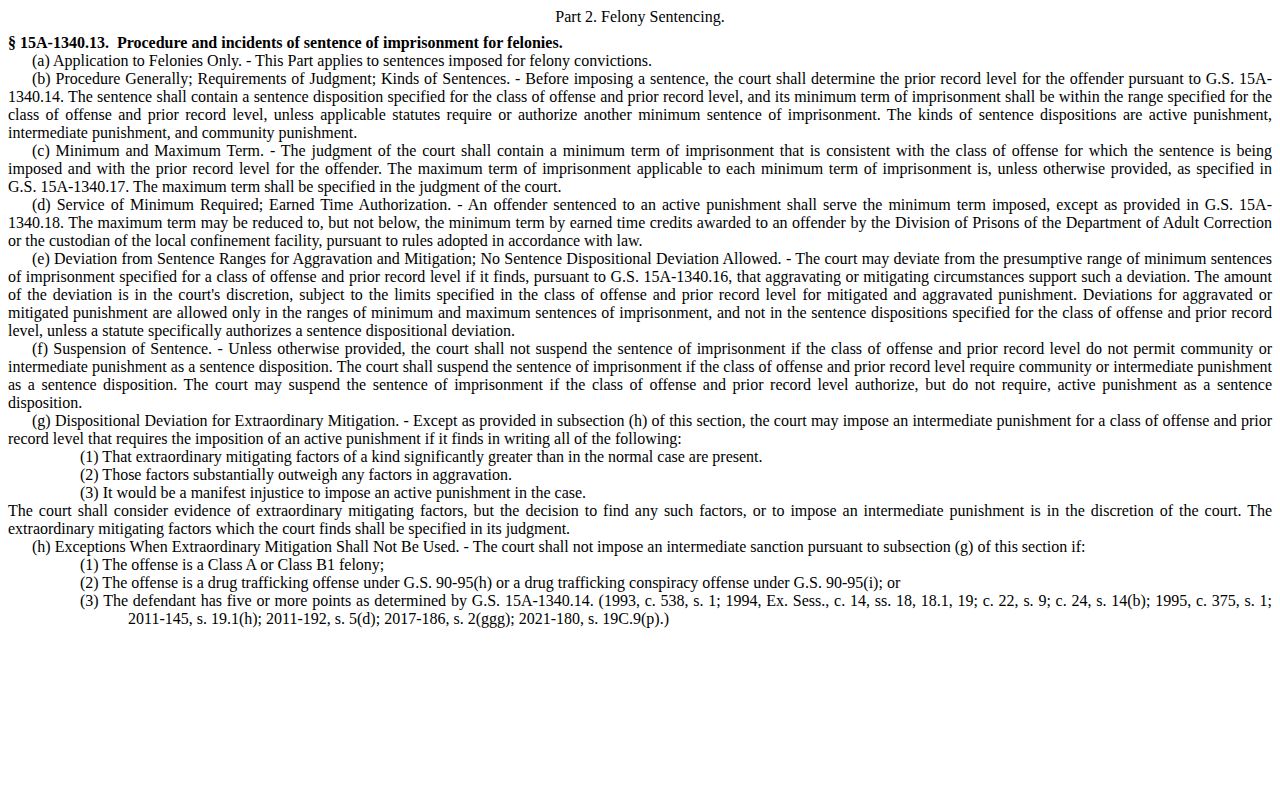
The statute anchors the key limit: earned time works against the maximum without ordinarily crossing the imposed minimum.
Note: Physical release into post-release supervision is not the same event as final termination of the sentence.
Stanly County Release Calculation Quirks
North Carolina law does not support a universal statement that each prisoner serves exactly 85 percent of a sentence. That shortcut can confuse the imposed minimum, the maximum, earned time, and the statutory period reserved for post-release supervision. The mandatory minimum-service rule is the legal floor for active felony punishment, subject to the statute's specific exceptions. Earned time works against the maximum term and cannot ordinarily cross the minimum.
The structural relationship between some paired terms can resemble an approximate percentage, but that does not make the percentage a flat credit against any sentence number. Felony class matters. The applicable maximum matters. Earned time, statutory supervision, and later sentence corrections also matter. A reliable Stanly County date lookup uses the actual DAC fields and governing sentence rules rather than a percentage estimate.
County jail calculations have a separate local limit: no Stanly-specific weekend-release statute, jail good-time schedule, or Sunday-to-Friday release rule was found in the official Sheriff material. The Sheriff page does not publish a county good-time policy. For a local sentence, request the jail's calculation and compare it with the judgment. Rules from another North Carolina county should not be imported into a Ralph McSwain release estimate.
Parole adds another narrow distinction. Under modern Structured Sentencing, post-release supervision is the usual path for covered felonies. Conventional parole mainly concerns older parole-eligible sentences and limited statutory groups. Eligibility for review is not a promised release date, and a favorable review is not proof that physical release occurred. A legacy parole case must be checked against the current DAC detail, the Commission's published action, and the later Actual Release Date.
The North Carolina post-release calculation statute is shown in the corresponding official source image.
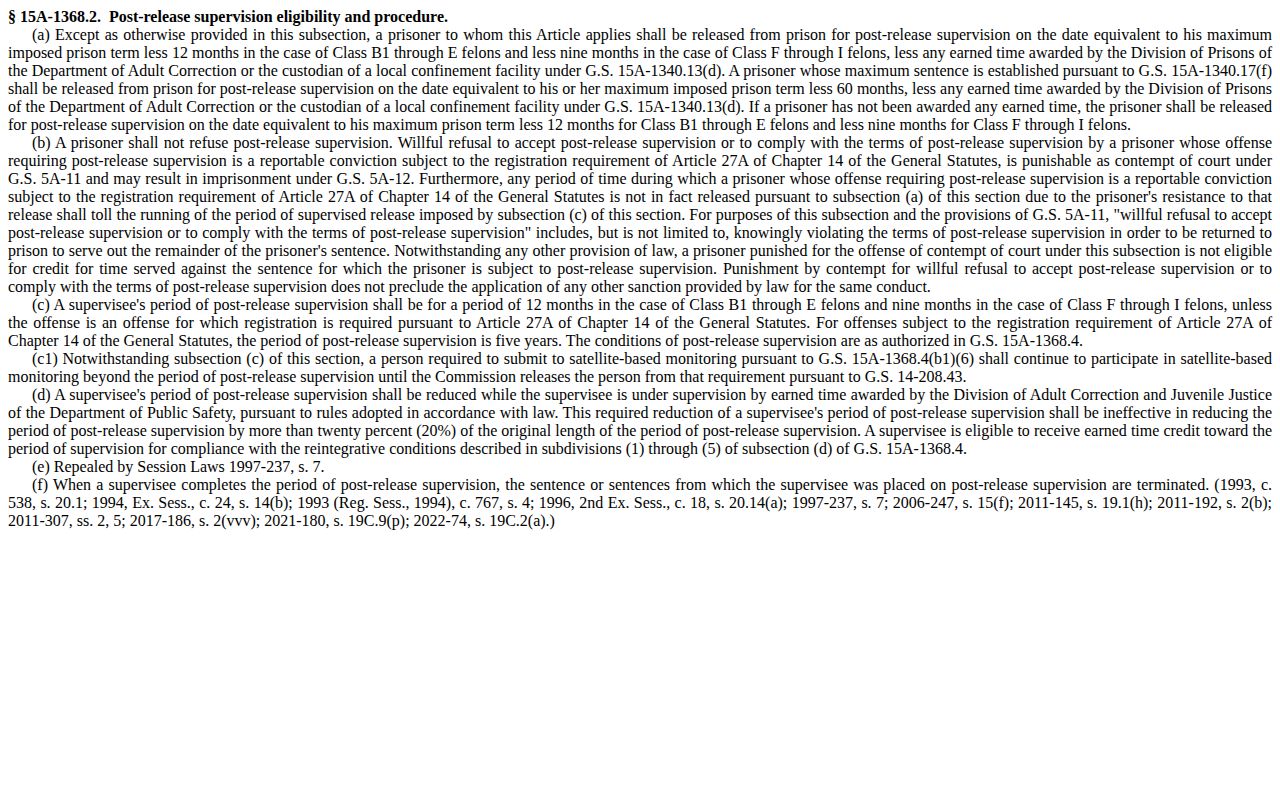
The class-based calculation explains why a simple statewide percentage is not an adequate substitute for the person's sentence record.
Why Stanly Release Dates Change
A projected date is recalculated when the legal or factual inputs change. Some changes move the date. Others change what happens at the date, such as release into supervision or transfer to another custodian. Read the updated DAC detail and the underlying court or custodian record before drawing a conclusion.
| Factor | Possible effect on the date or event |
|---|---|
| Earned-time accumulation or loss | Changes the credit applied against the maximum within statutory limits. |
| Disciplinary action | May affect earned time and cause a later recalculation. |
| Jail credit | Credited time can change the sentence computation when corrected or added. |
| Aggregated or consecutive terms | Multiple terms can alter the controlling period and projected endpoint. |
| Court amendment or vacatur | A later court order can revise or remove the sentence basis. |
| Parole action | For an eligible legacy sentence, a grant, denial, or later action may alter the path. |
| Detainer or new legal hold | May send the person to another custodian instead of producing community release. |
Public data can also change after an agency corrects a record. A future date is never a promise. The farther away it is, the more time remains for lawful credits, discipline, court action, or holds to alter the result. Pretrial county detainees do not fit this state-prison framework because their path depends on bond, charging decisions, court orders, and any other hold.
For a local detainee, a bond order may authorize release yet leave processing steps or another hold unresolved. For a state prisoner, a date may mark release into supervision rather than full sentence discharge. For a federal prisoner, a BOP date belongs to the federal system and is not a DAC projection. The label and custodian must stay attached to every date that is copied or shared.
Confirm Stanly County Release Dates
Use a four-point sequence for a state prisoner: Projected Release Date, NC SAVAN registration, Actual Release Date with current status, and the custodian's record. A pending alert can provide notice of change, but it cannot freeze a projection. Instructions for matching a record and registering appear on the Stanly County VINE inmate check.
When the date arrives, reopen DAC Offender Public Information. An Actual Release Date paired with active post-release or parole status means physical prison custody ended while supervision continues. A transfer on or near the projected date is not community release. If the public fields conflict, a narrow DAC public-record request can seek basic incarceration facts, sentence length, admission dates, and release dates.
For Ralph McSwain, use the Sheriff's detention-center contact and ask Booking whether the person physically left county custody or transferred. Compare the answer with the court judgment and later orders. A signed release order explains authority, while the jail record documents processing and exit. A person absent from the current Sheriff roster may have left the county building but entered DAC, another jail, ICE, or federal custody.