
Understanding Stanly County Releases
A release record links a booking or prison term to the event that ended physical custody. At the Stanly County Ralph McSwain Detention Center, a person may leave after posting bond, completing a local sentence, receiving a court-authorized discharge, or being transferred. Only some of those events place the person in the community. Transfer to the North Carolina Department of Adult Correction, another jail, the United States Marshals Service, or immigration custody means confinement continues under a new agency.
State-prison release works differently. Albemarle Correctional Institution is operated by NCDAC, not the Sheriff. Its release evidence appears in Offender Public Information as an Actual Release Date for the relevant incarceration period, read with current inmate and supervision status. A person may be out of prison yet remain on parole or post-release supervision. Complete discharge means the relevant prison and supervision service has ended, subject to any other case or custodian.
Important: Absence from the Stanly County current-inmate list does not prove release to the community. Confirm the event with the agency that held the person.
Stanly County Release Types
The words used for a Stanly County release matter. They describe why physical custody changed, not always the final result of a criminal case. Bond is a pretrial exit under set terms. A dismissal or acquittal resolves a charge, though jail processing may follow the court order later. Time served and sentence expiration describe completion of a stated custody term, but another hold can still control the person’s next destination.
| Release type | What it means | Next record to check |
|---|---|---|
| Bond or recognizance | Pretrial physical release under court-set conditions | Sheriff release event and court bond order |
| Time served or sentence end | The stated local custody term ended | Sheriff event, judgment, and any hold |
| Dismissal or acquittal | The court resolved the charge without conviction | eCourts disposition and physical exit record |
| Parole or post-release supervision | Prison custody ended while state supervision continues | NCDAC Actual Release Date and supervision status |
| Probation | A community sentence or supervision status | NCDAC supervision fields and court judgment |
| Transfer or detainer handoff | Custody moved to another agency | Receiving agency locator or record |
A death ends custody but should not be described as community release. Likewise, a projected date is not a completed event. The date may change, and only an actual release field or the custodian’s event record shows that the person physically left that custody period.
Stanly County Bond Releases
The Stanly County Sheriff’s published policy names three bond routes: a bail bondsman, cash bond, and property bond. The policy says a bondsman’s fee is typically 15 percent. For a property bond above $4,999, it says an attorney must prepare a Deed of Trust. Questions about bond stipulations go to 704-986-3858. Those are the Sheriff’s general published terms, not a promise that any route is available in a specific case.
Bond-out is a physical release before final case resolution. It does not dismiss the charge, erase the booking, or prove that all holds have cleared. The Sheriff release event should show the custody change, while the court record supplies the bond order and later case events. If another agency has a warrant or detainer, the person may be transferred rather than sent home.
Does posting bond prove the person walked out? No. Payment or a signed order gives legal authority for release, but the booking desk must complete processing and check other holds. Ask Booking for the physical status and request the release-event record when documentary proof is needed.
Note: A bond release and a final discharge answer different questions, so read the Sheriff event beside the court case.
Stanly County Release Record Fields
The Sheriff’s public roster does not show Stanly County release fields. The useful document is the underlying booking and release-event record. A narrow request ties the correct person to the correct custody period and asks for existing fields, rather than asking staff to prepare a new narrative. The booking photograph is a related identification record. It does not prove guilt, current custody, or the release result.
| Field | What it shows |
|---|---|
| Name and identifying number | Connects the event to the right booked person |
| Booking or admission date | Identifies the custody period that began |
| Releasing facility | Names the custodian that ended physical custody |
| Actual release date and time | Records when the custody event ended, if maintained |
| Authority or release type | States bond, sentence end, court order, transfer, or another basis |
| Bond details | Links a pretrial release to recorded bond terms |
| Destination or receiving agency | Distinguishes community release from continued custody elsewhere |
| Case, charge, or sentence link | Ties the custody event to its legal record |
| Supervision to follow | Shows parole or post-release status when held in the applicable system |
NCDAC separates past release from present status. Its Actual Release Date is tied to an incarceration period. Projected Release Date remains an estimate. A top-level POST RELEASE/PAROLE status or active supervision field shows that prison custody ended while legal supervision continues.
Request Stanly County Release Records
The Stanly County Public Information Request form is the document path for a local booking and release record. Select the fitting Public Safety Agency route. The form collects contact details, requested or needed dates, an information category, a description, and incident identifiers. No dedicated jail-record fee schedule, fixed turnaround, records-unit email, or separate office hours were published in the reviewed local sources.
- Identify the person by full name and aliases. Add date of birth only when needed to distinguish records.
- Give the inmate or booking number when known, plus an approximate booking date or date range.
- Ask for the existing booking and release-event record, actual release date and time, authority or type, public destination or receiving agency fields, bond or custody movements, and associated booking photograph.
- Use Sheriff administration at 704-986-3714 or Booking at 704-986-3739 if the request needs routing clarification.
The official Stanly County form makes the request channel clear. It does not promise that every requested field is public or maintained.
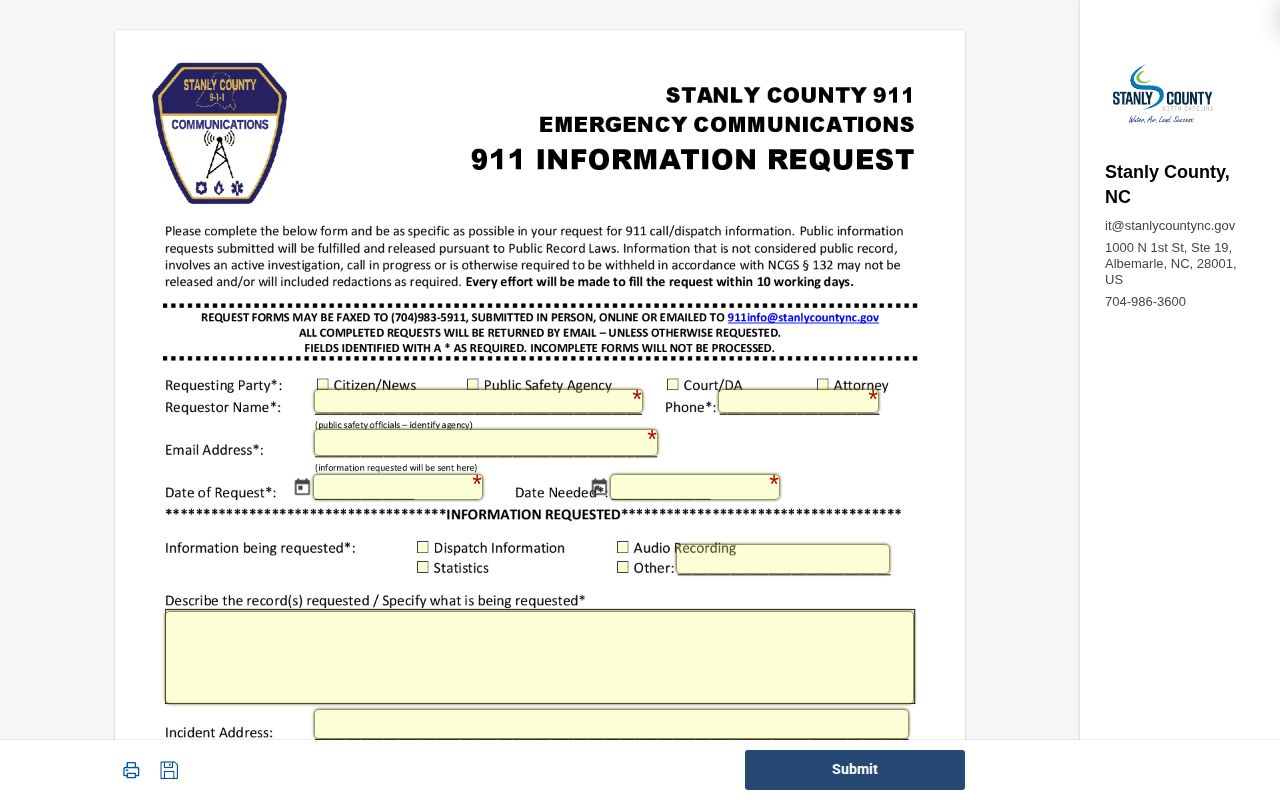
A concise request gives staff enough detail to locate one custody event while allowing protected portions to be separated under state law.
For a state-prison record, use the NCDAC public-records channel. DAC directs users to public Offender Information first and says simple requests may take days, while large or redaction-heavy requests may take weeks or months. It generally supplies electronic copies and need not create a record that does not exist.
Stanly County Release Record Law
North Carolina G.S. 132-1 broadly defines public records and includes photographs and electronic records made or received in public business, subject to other laws. G.S. 132-6 provides for inspection at reasonable times and copies as promptly as possible. It also bars an agency from making purpose or motive a condition of access and calls for public portions to be separated from confidential material when possible.
Under G.S. 132-6.2, ordinary uncertified copy charges generally cannot exceed actual reproduction cost unless another law applies. Extensive clerical, technical, or supervisory help can support a reasonable special service charge. Agencies do not have to create or compile a record that does not exist. G.S. 132-1.4 treats criminal investigation files differently while identifying certain public arrest and custody facts. It does not make the whole investigative file public.
Expunction is a court-ordered, statute-specific process under Article 5 of Chapter 15A. It is not automatic at release, dismissal, or the end of supervision. Juvenile, sealed, expunged, medical, security, and other protected details may be absent or withheld. No local rule found states how long a former booking remains online, since the Sheriff interface is a current-custody feed rather than a release archive.
Note: Ask for segregable public fields and a written legal basis when part of a mixed release record is withheld.
Stanly County Property After Release
Sheriff policy gives rules for property while a person is confined and says the inmate handbook is delivered through a kiosk. It does not publish a release-day property return method, a later pickup schedule, or a process for resolving release-record errors. Guessing from another jail’s practice can send a family member to the wrong place or at the wrong time.
Call Ralph McSwain Booking at 704-986-3739 about property tied to a specific release. The detention center is at 126 S. Third Street in Albemarle, while the Sheriff’s administrative office is at 223 S. 2nd Street. The research found no published basis for treating the administrative address as a release exit or property counter.
For a record error, start with the agency displaying it. The county request form covers Sheriff records, and NCDAC handles state prison or supervision records. Where an expunction or later court order controls, provide that documentation through the custodian’s correction or verification route. The correction request should identify the exact field and record rather than ask an unrelated agency to reconstruct the event.
Search Stanly County Released Inmates
A Stanly County released inmate search starts by identifying who last held the person. The Sheriff answers county-jail custody. NCDAC covers state prison and North Carolina community supervision. Courts explain orders and outcomes. VINE can corroborate an agency-fed status. Federal and immigration systems apply only when those agencies took custody.
- Search the Sheriff’s official current-inmate list by name. An IN record reports county custody. An absent name calls for more checks.
- Call Ralph McSwain Booking and ask whether the person physically left county custody or transferred. Request the release record when proof is needed.
- Check North Carolina SAVAN or VINELink under the correct Stanly Sheriff agency record. Treat a transfer alert as continued custody.
- Search NCDAC Offender Public Information under All. This catches an active inmate, an active person on supervision, and an inactive historic record.
- Review Stanly County eCourts records for the bond order, disposition, judgment, sentence, dismissal, or commitment that explains the legal basis.
- Use BOP, USMS, or ICE channels only for a federal or immigration custody path, then return to the actual custodian for the release file.
- When systems conflict or an older record is no longer online, request the record from the agency that held the person.
The absence of an official local feed is explained in the Stanly County 24-Hour Releases coverage. For one named person, the sequence above remains stronger than assuming a roster change equals freedom.
Stanly County Roster Release Gap
The Stanly Sheriff current-inmate interface is a live custody tool, not a recent-release archive. The research audit found 142 records, all coded IN. The page and its OCV/NCSWVINE feed had no OUT archive, release tab, actual release date, reason, authority, destination, or 24-hour and 72-hour filters. No official cadence or former-inmate retention policy was published.
The official Sheriff interface documents that current-custody design and the absence of a distinct release view.
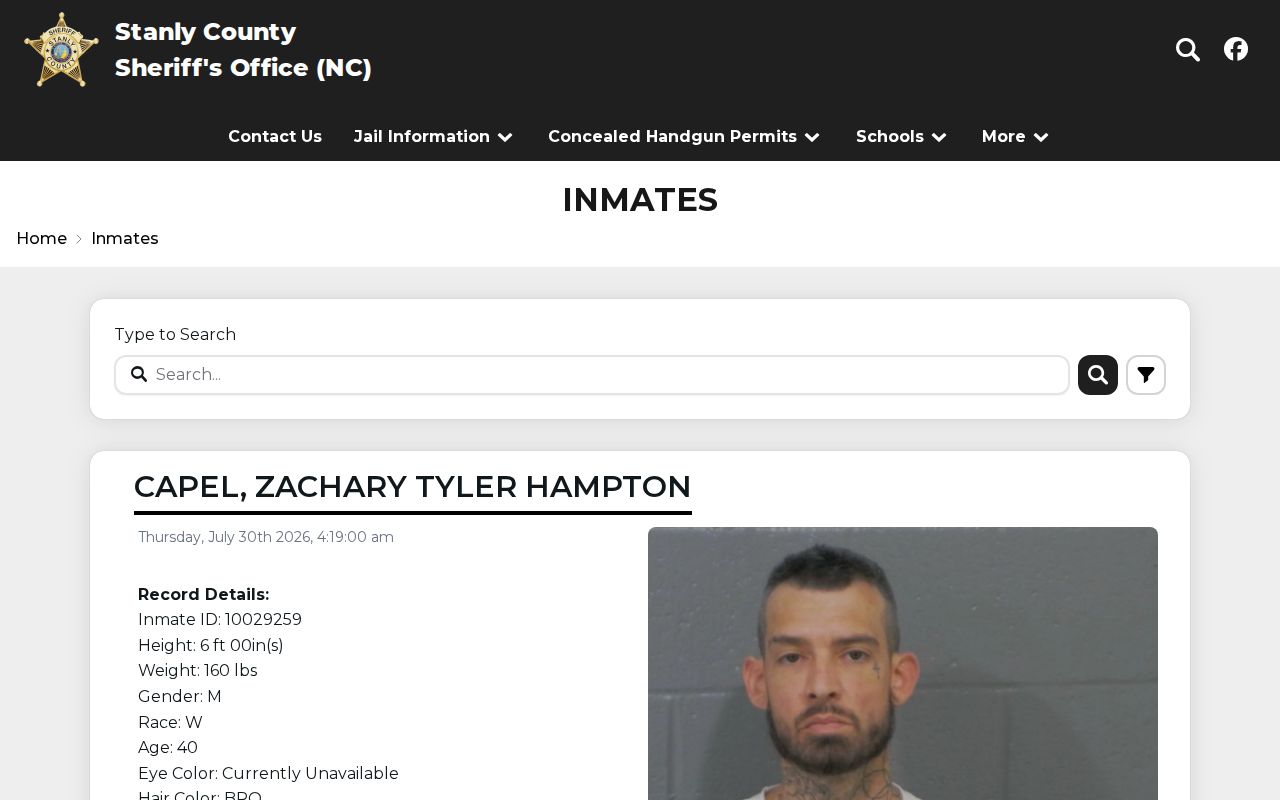
A name can vanish after bond, a local sentence, a transfer, a correction, or data lag. Booking and the underlying release event distinguish those outcomes.
Roster limit: A person still marked IN is reported in county custody. A missing name is inconclusive until the custody event is verified.
NCDAC Stanly County Release Search
The NCDAC Offender Public Information search covers people who served a DAC prison sentence or are or were under North Carolina probation, parole, or community supervision. It does not contain ordinary county-jail-only bookings. Begin with All. A person who left prison can remain Active as a probationer, parolee, or post-release supervisee and would be missed by an Inactive-only query.
| Search or result field | How to use it |
|---|---|
| Offender number | Best direct match when the DAC identifier is known |
| Name, sounds-like, birth date, age | Find and distinguish people when no number is available |
| All, Active Inmate, Active Supervision, Inactive | Choose All first so release under supervision is not missed |
| Inmate and supervision status | Distinguish prison custody, community supervision, and inactive history |
| Current and previous location | Show where the state record places the person |
| Actual Release Date | Documents physical release for that incarceration period |
| Projected Release Date | Shows an estimate, not proof that release occurred |
| Service, sentence, and parole dates | Explain whether state legal status remains active |
Open the correct detail and use the Most Recent Period of Incarceration unless an older event is the target. Read Actual Release Date with current inmate, sentence, service, and supervision fields. The monthly NCDAC Inmate Release Search can filter recent state releases by county, year, month, or name. Its STANLY choice means DAC recorded Stanly as the release county. It does not mean Ralph McSwain released the person.
Note: DAC documents public search history back to 1972, but that date is not a universal retention promise for every source file.
Stanly County Court Release Clues
The North Carolina eCourts Portal and Stanly County court page preserve case facts after a short jail stay ends. A case can show the charge, bond or release order, disposition, judgment, sentence, dismissal, or commitment to DAC. Search by case number when possible. Otherwise, match name, county, and dates with care.
Read entries in date order and give later orders priority when a judgment was changed or vacated. A signed release order explains legal authority, but it normally does not prove the minute jail staff completed the physical exit. Compare it with the Sheriff release event. When a judgment commits the person to state prison, stop using roster absence as the end point and follow the NCDAC record.
Can a court dismissal prove the jail release time? It can explain why release was authorized. It does not replace the Sheriff’s event record for the actual time or disclose whether another hold caused a transfer.
Stanly County Release Supervision
Physical release and legal discharge are separate. North Carolina post-release supervision follows prison for covered Structured Sentencing cases. Parole mainly applies to older parole-eligible sentences and limited statutory groups. Probation can be a community sentence and does not by itself prove that a person served state-prison time.
- Parole
- Conditional community release under rules for an eligible sentence.
- Post-release supervision
- A supervised community period that follows prison for covered sentences.
- Probation
- A court-ordered community sentence or status that may not follow prison.
- Discharge
- The end of the applicable custody or supervision service, not merely physical release.
- Absconder
- A public supervision status tied to alleged loss of contact or noncompliance, not proof of present jail custody.
Use NCDAC’s All or Active Probationer/Parolee search and read the Probation/Parole/Post Release Status and named office. Public status does not make officer notes, check-in details, or the full supervision file open. G.S. 15-207 protects information obtained by probation officers in official duty. More detail on interpreting these fields appears under Stanly County Post-Release Supervision.
Stanly County Release Notifications
North Carolina SAVAN connects county jails with Adult Correction prison, probation, and parole information. Through the North Carolina VINELink portal, a person can be searched by name or offender ID under the correct agency record. Compare the reporting agency, identifier, demographics, live status, effective date, and any release or transfer wording.
SAVAN can corroborate a change after a name leaves the Stanly roster, but it is not a certified historical ledger. Agency reports may lag. Some settings are excluded, including juvenile and mental facilities, police holding, and some people who bond out at the magistrate level without a jail booking. A no-result is not proof of release.
Registration is available from a matching record through Get Notified. Phone alerts use a private four-digit PIN for acknowledgement. A transfer usually requires finding the receiving record and registering again. The automated NC SAVAN hotline is 1-877-627-2826 and operates around the clock. Its notification timing does not guarantee real-time updating by a jail.
Federal and Immigration Release Checks
A Stanly County case can cross into federal or immigration custody even though no separate federal or ICE detention facility was identified in the county directories reviewed. For a sentenced federal prisoner, the BOP Inmate Locator commonly shows name, register number, age, race, sex, release date, and location or status. Released or Not in BOP Custody means only that BOP no longer holds the person. State, county, ICE, and federal supervised-release status still require their own checks.
USMS manages many federal pretrial custody movements but has no nationwide public released-person locator. Identify its contract custodian through the case record and use USMS records procedures where appropriate. ICE’s Online Detainee Locator searches by A-number and birth country or by exact name and birth country, with an optional date of birth. It is not a permanent release archive.
An immigration detainer handoff is a transfer, not community release. Follow the receiving agency and the federal docket or order, then seek records from the custodian that actually controlled the event.
Getting Home After Stanly Release
SCUSA Transportation provides subscription and demand-response van or bus service in Stanly County. Appointment requests are taken from 8 a.m. to 5 p.m., should be made at least 48 hours in advance, and are scheduled first come, first served. The service is not advertised as a jail pickup or a same-day release ride.
An unplanned discharge may therefore require a ride arranged through family, counsel, or another available option. The Sheriff publishes no family waiting point, public release door, exit schedule, or weekend and holiday release procedure. Call Booking before selecting a pickup spot. The detention center’s Third Street address should not be confused with the Sheriff administrative office on South Second Street.
No source supports a set hour when Stanly County released inmates leave, and no generic jail schedule should be applied. Transportation plans should remain flexible until Booking confirms that processing is complete and says where lawful pickup may occur.
Note: SCUSA can help with planned trips, but its advance-request model does not establish a same-day jail release service.
Stanly County Reentry Releases
NCDAC designates Albemarle Correctional Institution as a reentry facility. It is a 624-capacity, male medium-custody state prison near New London. That makes Stanly County home to both a county jail and a state reentry institution, but the designation does not prove that each person will settle in Stanly County after release.
A person may transfer to another prison, return to another county, or begin supervision through a different office. Use the individual NCDAC record. Actual Release Date establishes the physical prison exit for the matching incarceration period, while current status and Probation/Parole Office identify ongoing state supervision. Facility location is not a substitute for a recorded release county or destination.
The state prison’s role also explains why a person can be physically free yet have an ACTIVE status. Community supervision is a legal continuation of the sentence, not prison custody. Full discharge requires reading the service and supervision fields beyond the release date.
Two Stanly County Release Systems
The Ralph McSwain Detention Center and Albemarle Correctional Institution are different types of custodians. Ralph McSwain is the county detention center at 126 S. Third Street, Albemarle, operated by the Stanly County Sheriff. Its Booking number is 704-986-3739. A community exit needs the Sheriff booking and release event, supported as needed by a court order or NC SAVAN status.
Albemarle Correctional Institution is an NCDAC prison at 44150 Airport Road, New London. Its main number is 704-244-8700. The scalable historic path is the statewide NCDAC offender search, not the county roster. A transfer from Ralph McSwain to Albemarle means incarceration continues. A move between prisons also is not release.
The distinction changes each Stanly County release search. Sheriff roster disappearance raises a question that the local event record must answer. A state-prison discharge is shown by the most recent NCDAC Actual Release Date plus present inmate and supervision status. Mixing the two creates false conclusions about both custody and destination.
Stanly County Release Lookup Paths
Choose the source by both custody type and time. A current Sheriff IN record means the public feed still reports county custody. A Sheriff release event documents how that local period ended. An NCDAC Actual Release Date applies to a state incarceration period. Court records supply legal authority, while VINE gives an agency-fed status and notifications.
- Still in Ralph McSwain custody
- Use the Sheriff current-inmate list and confirm time-sensitive facts with Booking.
- Released from Ralph McSwain
- Request the Sheriff booking and release event, then compare court and SAVAN records.
- Transferred to state prison
- Use NCDAC Offender Public Information. County roster absence is not release.
- Released from state prison
- Read the most recent Actual Release Date with present supervision and service status.
- Federal or immigration custody
- Use BOP, the federal case and USMS custodian, or ICE ODLS according to the case.
Identity should be matched with an official number when possible. Otherwise compare full name, date of birth or age, agency, case jurisdiction, and dates. A photograph is only one identity aid, and a same-name record or single absent result is not enough.
Stanly County Release Facilities
Two long-term detention facilities were identified in the official Stanly County, state, and federal directories reviewed. No separate federal, ICE, regional, or municipal long-term detention facility was found in Stanly County. That bounded directory result does not rule out short police holds or an out-of-county contract bed in a specific case.
Stanly County Ralph McSwain Detention Center: This county jail holds Sheriff detainees. Community release is confirmed through Booking and the local release-event record; transfers must be followed to the receiving custodian.
Albemarle Correctional Institution: This NCDAC state prison holds sentenced male inmates in medium custody. Community release or supervision is confirmed through NCDAC Actual Release Date and current status, while prison-to-prison movement remains custody.